
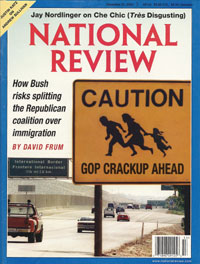
Originally published on National Review December 31, 2004, page 30.
One Man's Marriage Trap
The ever-shifting, deeply conflicted Andrew Sullivan
When Andrew Sullivan was seven or eight, the visceral yet distancing medium of television sparked a feeling about which many men will have corresponding stories. A shirtless actor elicited "such an intense longing" that young Andrew "determined to become a doctor" so he could "render the man unconscious and lie on top of him when no one else was in the room." Its furtive nature may be distinct from the similar memories of others, but the bewildering indication of inchoate sexuality is familiar.
Years later, Sullivan volunteered to assist a stranger through the final months of life with AIDS. The scene presents an eerie echo. "I remember one day lying down on top of him to restrain him as his brittle, burning body shook uncontrollably with the convulsions of fever."
If Sullivan noticed the parallel between these moments — described in his books Virtually Normal and Love Undetectable, respectively — he hasn't said so, but their implications could fill another book. The child's undefined desire for closeness, and the solitude of a man's deterioration. The vision of exploiting a doctor's power, and the reality of a nurse's powerlessness. An awakening to sexuality, and to solidarity.
Different people will derive conflicting lessons from these anecdotes, but this is often the case with Sullivan. He's unapologetically homosexual and, until recently, devoutly Catholic. His social sympathies are liberal, but he's often presented as conservative. He has written many times for the New York Times, but he is a leading figure in a blogosphere that sees the Times as the establishment it opposes.
Taken altogether, these qualities attract an interesting audience, and conservatives' criticism of Sullivan's opinions often begins with confessions of fandom or friendship. In particular, conservatives have generally appreciated his steadfast advocacy for a vigorous prosecution of the war on terrorism. The niche that he has claimed, however, has made Sullivan an especially influential advocate for a cause with which many of them do not agree: same-sex marriage. In his various expositions of the case for same-sex marriage over the years, Sullivan has trapped himself in a series of opportunistic contradictions — which may tell us something about the contradiction at the heart of his cause.
The Dance
Virtually Normal (1995) is Sullivan's unique perspective presented as a political argument. As a polemical feat, his strategy is brilliant, transforming the terms of the debate and providing a clear platform from which to volley objections. As an assessment of people's thinking, however, it stumbles on its own cleverness.
His handling of religion strains most palpably. In his chapter on "the prohibitionists" — the strongest opponents of homosexuality — Sullivan quotes St. Paul's most indisputable denunciation of it, Romans 1:27. Providing neither chapter nor verse, Sullivan moves immediately to speculation about Paul's intent: Homosexuality supposedly serves merely as "an analogy" for continued polytheism, exploited only because Paul "seems to assume that every individual's nature is heterosexual." Put in context, however, the reference is more apparently a manifestation of the larger sin Paul has in mind: the rejection of that which can be "perceived in the things that God has made."
Over the years, this divergent exegesis has spun to schismatic lengths. In November 1994, in The New Republic, Sullivan called his reading of St. Paul "so obvious an alternative... that it is hard to imagine the forces of avoidance that have kept it so firmly at bay for so long." In Love Undetectable (1998), fear-driven "loathing" of homosexuals and Jews is "fanned... by the distortion of a particular strain in Christian theology." By August 2003, the Catholic Church's failure to succumb to this alternative indicated a "war on gay people and their dignity."
This is not to deny that Sullivan can be genuinely insightful, but too often, his analysis of competing viewpoints is designed merely to generate elaborate debaters' points. The trick is to push opponents of same-sex marriage into a circumscribed pen, ruling certain lines of reasoning out of order. Already, in the afterword of the paperback edition, concerns about the instability of male homosexual relationships are declared "a truly bizarre argument for a conservative to make."
Similarly, the old-media technique of loaded labeling has helped Sullivan to fence in conservatives. The Federal Marriage Amendment is the "religious right amendment," not a cause of respectable conservatives, on the theory that its strongest backers are evangelical Christians. When Senate majority leader Bill Frist expressed support for it in June 2003, Sullivan bewailed "how close to theocracy today's Republicans have become." The spark for the charge was one word: Frist had described marriage as a "sacrament."
"Theocon" is a perennial smear in Sullivan's writing. Theoconservatism, he explained in a 1998 New York Times Magazine cover story, is "an orthodoxy... of cultural and moral revolution." (On the cover, a finger pointed over red letters: "The Scolds.") Sullivan notes the opposition of alleged theocon Fr. Richard John Neuhaus to "secular monism." By this phrase, Neuhaus means the antithesis of true pluralism, wherein a sacralized state claims to be the arbiter of truth, with no reference to or respect for the religious beliefs of its citizens. Sullivan makes "secular monism" seem less threatening, and Neuhaus more extreme, by redefining it as merely "the secular neutrality of modern American law and government." That is a subdued definition indeed from a man for whom a favorite slogan for the FMA is "graffiti on a sacred document."
Sullivan confesses in its afterword that Virtually Normal is "a profession of faith in liberal politics." His essential dogma is "public neutrality and private difference." The paradox derives from the fact that the "centerpiece" of Sullivan's proposal in that book — marriage — is the basic interface between culture and politics, where the private becomes public.
Sullivan himself has had difficulty adhering to the bifurcation. When Senator Rick Santorum uttered his infamous remarks about the erosion of morality-based laws should the Supreme Court's Lawrence v. Texas decision make sodomy a right, Sullivan indulged in a days-long excoriation. He dismissed Santorum's argument for not making the public/private distinction: "Bigamy and polygamy are... irrelevant here," because they involve marriage, about which a right to sodomy implied nothing. Two months later, reveling in Lawrence's outcome, Sullivan declared that the expansion of privacy rights "inescapably means the right to marry."
The institutional truth that marriage is both public and private has brought into the battle over its legal definition the most fundamental of our laws, the Constitution. The Full Faith and Credit Clause has dramatically changed roles in Sullivan's usage. In 1996, he laughed in the Sunday Times of London that "the punchline" of judicially imposed same-sex marriage in Hawaii was that "every state has to give 'full faith and credit' to the laws of every other state." When Congress debated the Defense of Marriage Act, meant to keep states from being forced to recognize other states' redefined marriages, Sullivan opposed the bill in testimony: It was up to the Supreme Court to decide whether states would be compelled to grant recognition. After the bill passed, Sullivan insisted that it was unconstitutional — which, he claimed in August 2003, "the social right knew at the time and still knows."
At other times, Sullivan argues that a constitutional amendment is unnecessary because of the very same Defense of Marriage Act. In July of last year, he said that the act had the power "to stop one state's marriages being nationalized." By November, he was declaring the suggestion that the courts might force one state to recognize another state's same-sex marriages "disingenuous." He wrote this February that if the courts were to strike down the act — if "one single civil marriage in Massachusetts is deemed valid in another state, without that other state's consent" — he would support a constitutional amendment to "say that no state is required to recognize a civil marriage from another state." His standard for "consent," however, is a tenuous barrier, given his view that state courts are qualified to offer it.
Unraveling the threads of rhetoric, it appears that Sullivan thinks the FMA is unnecessary because of the Defense of Marriage Act, although he opposed that act and wants the Court to strike it down. Once that happens, he will, supposedly, be in favor of a constitutional amendment to effect the stricken act's purpose, so that courts can dismantle it again state by state.
Periodically, this twirling of convenient views moves from frustrating to astonishing. In January, Stanley Kurtz published an argument against same-sex marriage based on an examination of familial trends in Scandinavia, where social policy toward gays has long been especially permissive. "Did no one edit this?" Sullivan attacked, saying that Kurtz's analysis "would be laughed out of a freshman social science class." Simply, "the entire premise of the piece — that marriage for gays is legal in Norway, Denmark and Sweden — is factually untrue."
Yet the previous June, when he thought that evidence from Denmark supported his case for same-sex marriage, Sullivan had written that Denmark's gay partnerships were "almost indistinguishable from marriage." In his 1997 collection Same-Sex Marriage: Pro and Con, he noted that "different compromises" in Denmark and Sweden "affect the meaning of marriage itself." Throughout the intervening years, in multiple venues and contexts, he touted "de facto marriages." In August 2001, for example, he wrote that trends were hopeful during "the first six years in which gay marriage was legal in Denmark" (Sunday Times) and that the country provided "real data on the impact of gay marriage" (The New Republic).
When he thought empirical evidence in Scandinavia pointed his way, Sullivan conceded that the "importance of the family in society is indisputable." The politics of Virtually Normal do not, however, ultimately emphasize benefits for society. It is the benefits for homosexuals that are uppermost in Sullivan's argument. Any social difficulties that a redefinition of marriage would create he would leave to the "private sphere" to solve. No public norm can be imposed, because "outsiderdom" must be "a cultural choice," and homosexual identity must be free from "the hands of the other." (The lapse into pomo-speak is telling.)
But to conservatives, a large part of the purpose of marriage is precisely to discourage "outsiderdom" and to encourage citizens toward specific, society-sustaining identities. To Sullivan, on the other hand, marriage is a mechanism to gain "personal integrity" and "dignity," to become "fully human." A major source of friction between these two approaches is the effect that the latter's understanding of marriage might have on the ability to achieve the goals of the former. In that respect, it is relevant what Sullivan considers the fundamental determinant of "full humanity" to be.
A Messy Marriage of Concepts
In Love Undetectable, Sullivan raises the concept when discussing the act of sex. Sex involves a loss of control and submergence of intellect, and to give those things up "even under the threat of death" would be "to give up being fully human." The passage calls to mind Sullivan's greatest miscalculation in Virtually Normal, which occurs in the epilogue, while he is waxing philosophical about the meaning of homosexuality.
There, he argues that features of homosexual relationships "could nourish the broader society." Lesbians' "sexual expressiveness" and gay men's "solidity and space" are sometimes "lacking in more rote, heterosexual couplings." He speaks of "the openness of the contract," of "the need for extramarital outlets," of "flexibility." In response to critics' seizing on this passage as contemptuous of monogamy, Sullivan has asserted — and there's no reason to doubt — that he did not intend an endorsement of adultery. Affairs among married homosexuals, he clarifies in the paperback's afterword, should be "as anathema as" among married heterosexuals. The lessons implied for heterosexuals "are not direct ones." Understandable bewilderment at this passage, however, distracts from what is truly problematic here.
Sullivan seems to take for granted that heterosexuals are driven toward "timeless, necessary, procreative unity," whereas homosexuals must be given space beyond the "stifling model of heterosexual normality." He is even willing to place procreative marriages on a pedestal. In the spring of 2003, he proclaimed the "unique and miraculous... connection between male-female sex and the creation of new life." That connection's alignment with "a marital structure... is obviously vital to defend." It is at the heart of his cause, however, to reorder the structure from within.
In this context, here's the truly disquieting statement of those controversial pages: "The truth is, homosexuals are not entirely normal; and to flatten their varied and complicated lives into a single, moralistic model is to miss what is essential and exhilarating about their otherness." The truth that Sullivan evades is that flattening to a model is precisely marriage's social purpose, and furthermore, his arguments for same-sex marriage are in conflict with the desire he expresses in this passage to preserve homosexuality's "otherness."
After all, how can "otherness" be preserved if distinctions are effaced? Sullivan's writing overflows with appeals to equality untinted by distinctions, as when he rejects "the mealy-mouthed talk about civil unions as some sort of options for gay citizens." The exclusion of same-sex couples is indefensible when, he says (incorrectly), "the living, breathing reality of civil marriage in America" is coupling and nothing more. Just before Thanksgiving, this year, he pushed his equality-based argument almost to the point of making the case for the FMA (emphasis his):
Of course, Sullivan opposes amendments intended to prevent the law from locking in mere coupling as the open-ended definition of marriage. He's also quick to attack those who seek to bolster marriage's vital connections from other angles. In July 2001, for example, he expressed astonishment at Lawrence Kudlow's implicit support for adultery laws. "Give me an adulterer over an ayatollah any day," wrote Sullivan. He has lambasted "screw-tightening" fundamentalists for targeting divorce, fornication — the whole arsenal of practices subversive to marriage. Yet, in January, he said of the same group that, when they "start proposing measures that would infringe on heterosexual abuse of marital privileges, [he will] take them seriously." If social conservatives target heterosexual as well as homosexual immorality, they are fanatics; if they don't, they are hypocrites.
In parallel debates among Catholics, Sullivan's prescription for addressing rampant sexual license is its legitimization. "Why can we not hold up marriage and committed loving relationships as the goal but not punish and stigmatize the non-conformists or those whose erotic needs and desires are more complex?" But it simply isn't clear how he thinks society should avouch its supposed goal. In Virtually Normal, he challenges the notion that it is better for a "waverer" to choose heterosexuality. In a later attempt to dismantle a column by William Bennett, he asks what is "so bad, after all, with mutual objectification."
Sullivan has written that many gay men value their sexual freedom, while many "yearn for anchors." In The New Republic, in August 2001, he cast his sympathy with the former, and in June 2002, he admitted that he would be among "those who choose not to marry." This may be surprising, given his long advocacy for what he calls "marriage rights." But in Love Undetectable, he describes sex itself as "almost a sacrament of human existence." A year ago, he said it's "one of the greatest and most exhilarating gifts our nature has given us." (Our nature?) In fact, "reduction" of it to "pure, heterosexual, procreative sex" is "excessively strict, given the not-so-terrifying moral dangers of other forms."
So in Sullivan's world of sacramental sex and moralistic marriage, what is the basic marker of "full humanity"? In the New York Times Magazine, in February 2001, he wrote approvingly of the dissipation of "the idea that no woman is complete without a man." Can it really be his position that no man is complete without a man? That those outside of legally recognized relationships are not "fully human"? Of course not. To Sullivan, possession of choice defines humanity, and "full humanity" is a relative measure. For gays, to have "full humanity" is to have the same range of choices that straights have. Whether the extension of a particular choice to homosexuals is at odds with the fundamental reason it exists in the first place is, from that point of view, irrelevant.
Given Sullivan's leveling conception of equality, he can't wish for homosexuals to gain the choice of marriage without also wishing for heterosexuals to gain the choices that gays' freedom from procreation naturally grants them. In such a field of options, society would have no remaining leverage to push for marriage. Sure, it could grant material benefits on the basis of commitment. Yet, even if we believe that marriage stops expanding with the inclusion of homosexuals, even if we believe that the standard for monogamy slips no further, Sullivan's "conservative case" collapses. One cannot simultaneously want no choice to bear stigma while presenting one choice as an expectation.
By Any Means Necesary
Sullivan has considered every strategy for nationalizing same-sex marriage — and he likes them all. To be sure, he has made it a talking point that time for persuasion is "the genius of a federal system," a "slow federal process [that he wants] to take place"; warnings of rapid change in the absence of a Federal Marriage Amendment are "scare tactics." He writes: "The flip-side of leaving Mississippi alone is that we should also leave Massachusetts alone. Deal?"
He constantly attacks the Federal Marriage Amendment as an offense against federalism. But when Ramesh Ponnuru pressed him on the point, this February, Sullivan clarified that while he believes in "winning over the public" and working "legislatively if at all possible," he would also support a Supreme Court finding that the Constitution demands legal recognition of same-sex marriage from coast to coast.
The judiciary is a central component of his politics. A December 2002 blog post explained that "individual states should be able to decide for themselves" about marriage — in state courts, "where marriage questions rightly belong." In July 2003, he reflected in the Sunday Times that the courts were changing hands to "judges who reflect contemporary understanding." (Apparently, they do so better than the public's elected representatives.)
After Lawrence, Sullivan confessed that he was happy that the ruling had gone far beyond "the narrowest possible grounds." Goodridge in Massachusetts convinced him "how impossible it is that any reasonable court" could deny gays marriage. For Sullivan, "democratic deliberation" must be a process whereby judges implement federal law; in the slow version, they do so state by state. Any movement to force actual votes indicates an "hysterical and polarizing campaign" and "unbounded paranoia with respect to courts."
To derail such campaigns, Sullivan will stroke racial tensions. He pioneered the usurpation of civil rights imagery for circumstances of such loose comparison that history needs knots to hold. The courage of taking a seat in a violent environment of ingrained racism is commandeered for ceremonies invited by local government and backed by the national media, the academy, and the bar. The Catholic Church's opposition to fundamental changes to the institution of marriage is taken to be akin to its support of slavery in 1866 — never mind that the documents Sullivan adduced as evidence of that support demonstrated no such thing. (They concerned penal servitude and the like, not slavery.)
Similarly, he will jab emotions made bare through religious friction. In his piece about "The Scolds," Sullivan wrote that it was "perhaps unsurprising that, when Neuhaus gathered a group of public thinkers and ministers to endorse a statement" of their political position, "there were no Jews among the signers." Unsurprising, indeed, for a letter subtitled, "A Statement of Christian Conscience and Citizenship."
The charitable explanation is that Sullivan has gotten so caught up in his cause, so feels the tingle of proximate success, that he doesn't hear his conflicting arguments draining empathy. Whatever the case, he long ago sank into naked advocacy. His work must now be approached like the material of a civil-action lawyer or lobbyist. When President Bush announced support for a marriage amendment, Sullivan reacted violently. All people of goodwill would have to oppose the president. He's said that the "fair-minded center of the country that balks at... hatred and fear" would never stand for pandering to extremists. But the emotional extremism on display in his writings is chiefly his own.
Andrew Sullivan seems, in short, to have an intellect in deep conflict with his emotions. His language practically glows with warmth when the next generation of gays appears in his writing. True to form, however, he began Virtually Normal with a contradictory admission:
Same-sex marriage became law in Massachusetts on the anniversary of Brown v. Board, and Sullivan naturally drew the parallel. To him, same-sex marriage is a matter of gays' integration into their own families. But even if the marriage episode concludes as Sullivan wishes, choices will still be beyond reach, requiring redirected advocacy. There will always be something for which to long intensely on the other side of the glass.
Years later, Sullivan volunteered to assist a stranger through the final months of life with AIDS. The scene presents an eerie echo. "I remember one day lying down on top of him to restrain him as his brittle, burning body shook uncontrollably with the convulsions of fever."
If Sullivan noticed the parallel between these moments — described in his books Virtually Normal and Love Undetectable, respectively — he hasn't said so, but their implications could fill another book. The child's undefined desire for closeness, and the solitude of a man's deterioration. The vision of exploiting a doctor's power, and the reality of a nurse's powerlessness. An awakening to sexuality, and to solidarity.
Different people will derive conflicting lessons from these anecdotes, but this is often the case with Sullivan. He's unapologetically homosexual and, until recently, devoutly Catholic. His social sympathies are liberal, but he's often presented as conservative. He has written many times for the New York Times, but he is a leading figure in a blogosphere that sees the Times as the establishment it opposes.
Taken altogether, these qualities attract an interesting audience, and conservatives' criticism of Sullivan's opinions often begins with confessions of fandom or friendship. In particular, conservatives have generally appreciated his steadfast advocacy for a vigorous prosecution of the war on terrorism. The niche that he has claimed, however, has made Sullivan an especially influential advocate for a cause with which many of them do not agree: same-sex marriage. In his various expositions of the case for same-sex marriage over the years, Sullivan has trapped himself in a series of opportunistic contradictions — which may tell us something about the contradiction at the heart of his cause.
The Dance
Virtually Normal (1995) is Sullivan's unique perspective presented as a political argument. As a polemical feat, his strategy is brilliant, transforming the terms of the debate and providing a clear platform from which to volley objections. As an assessment of people's thinking, however, it stumbles on its own cleverness.
His handling of religion strains most palpably. In his chapter on "the prohibitionists" — the strongest opponents of homosexuality — Sullivan quotes St. Paul's most indisputable denunciation of it, Romans 1:27. Providing neither chapter nor verse, Sullivan moves immediately to speculation about Paul's intent: Homosexuality supposedly serves merely as "an analogy" for continued polytheism, exploited only because Paul "seems to assume that every individual's nature is heterosexual." Put in context, however, the reference is more apparently a manifestation of the larger sin Paul has in mind: the rejection of that which can be "perceived in the things that God has made."
Over the years, this divergent exegesis has spun to schismatic lengths. In November 1994, in The New Republic, Sullivan called his reading of St. Paul "so obvious an alternative... that it is hard to imagine the forces of avoidance that have kept it so firmly at bay for so long." In Love Undetectable (1998), fear-driven "loathing" of homosexuals and Jews is "fanned... by the distortion of a particular strain in Christian theology." By August 2003, the Catholic Church's failure to succumb to this alternative indicated a "war on gay people and their dignity."
This is not to deny that Sullivan can be genuinely insightful, but too often, his analysis of competing viewpoints is designed merely to generate elaborate debaters' points. The trick is to push opponents of same-sex marriage into a circumscribed pen, ruling certain lines of reasoning out of order. Already, in the afterword of the paperback edition, concerns about the instability of male homosexual relationships are declared "a truly bizarre argument for a conservative to make."
Similarly, the old-media technique of loaded labeling has helped Sullivan to fence in conservatives. The Federal Marriage Amendment is the "religious right amendment," not a cause of respectable conservatives, on the theory that its strongest backers are evangelical Christians. When Senate majority leader Bill Frist expressed support for it in June 2003, Sullivan bewailed "how close to theocracy today's Republicans have become." The spark for the charge was one word: Frist had described marriage as a "sacrament."
"Theocon" is a perennial smear in Sullivan's writing. Theoconservatism, he explained in a 1998 New York Times Magazine cover story, is "an orthodoxy... of cultural and moral revolution." (On the cover, a finger pointed over red letters: "The Scolds.") Sullivan notes the opposition of alleged theocon Fr. Richard John Neuhaus to "secular monism." By this phrase, Neuhaus means the antithesis of true pluralism, wherein a sacralized state claims to be the arbiter of truth, with no reference to or respect for the religious beliefs of its citizens. Sullivan makes "secular monism" seem less threatening, and Neuhaus more extreme, by redefining it as merely "the secular neutrality of modern American law and government." That is a subdued definition indeed from a man for whom a favorite slogan for the FMA is "graffiti on a sacred document."
Sullivan confesses in its afterword that Virtually Normal is "a profession of faith in liberal politics." His essential dogma is "public neutrality and private difference." The paradox derives from the fact that the "centerpiece" of Sullivan's proposal in that book — marriage — is the basic interface between culture and politics, where the private becomes public.
Sullivan himself has had difficulty adhering to the bifurcation. When Senator Rick Santorum uttered his infamous remarks about the erosion of morality-based laws should the Supreme Court's Lawrence v. Texas decision make sodomy a right, Sullivan indulged in a days-long excoriation. He dismissed Santorum's argument for not making the public/private distinction: "Bigamy and polygamy are... irrelevant here," because they involve marriage, about which a right to sodomy implied nothing. Two months later, reveling in Lawrence's outcome, Sullivan declared that the expansion of privacy rights "inescapably means the right to marry."
The institutional truth that marriage is both public and private has brought into the battle over its legal definition the most fundamental of our laws, the Constitution. The Full Faith and Credit Clause has dramatically changed roles in Sullivan's usage. In 1996, he laughed in the Sunday Times of London that "the punchline" of judicially imposed same-sex marriage in Hawaii was that "every state has to give 'full faith and credit' to the laws of every other state." When Congress debated the Defense of Marriage Act, meant to keep states from being forced to recognize other states' redefined marriages, Sullivan opposed the bill in testimony: It was up to the Supreme Court to decide whether states would be compelled to grant recognition. After the bill passed, Sullivan insisted that it was unconstitutional — which, he claimed in August 2003, "the social right knew at the time and still knows."
At other times, Sullivan argues that a constitutional amendment is unnecessary because of the very same Defense of Marriage Act. In July of last year, he said that the act had the power "to stop one state's marriages being nationalized." By November, he was declaring the suggestion that the courts might force one state to recognize another state's same-sex marriages "disingenuous." He wrote this February that if the courts were to strike down the act — if "one single civil marriage in Massachusetts is deemed valid in another state, without that other state's consent" — he would support a constitutional amendment to "say that no state is required to recognize a civil marriage from another state." His standard for "consent," however, is a tenuous barrier, given his view that state courts are qualified to offer it.
Unraveling the threads of rhetoric, it appears that Sullivan thinks the FMA is unnecessary because of the Defense of Marriage Act, although he opposed that act and wants the Court to strike it down. Once that happens, he will, supposedly, be in favor of a constitutional amendment to effect the stricken act's purpose, so that courts can dismantle it again state by state.
Periodically, this twirling of convenient views moves from frustrating to astonishing. In January, Stanley Kurtz published an argument against same-sex marriage based on an examination of familial trends in Scandinavia, where social policy toward gays has long been especially permissive. "Did no one edit this?" Sullivan attacked, saying that Kurtz's analysis "would be laughed out of a freshman social science class." Simply, "the entire premise of the piece — that marriage for gays is legal in Norway, Denmark and Sweden — is factually untrue."
Yet the previous June, when he thought that evidence from Denmark supported his case for same-sex marriage, Sullivan had written that Denmark's gay partnerships were "almost indistinguishable from marriage." In his 1997 collection Same-Sex Marriage: Pro and Con, he noted that "different compromises" in Denmark and Sweden "affect the meaning of marriage itself." Throughout the intervening years, in multiple venues and contexts, he touted "de facto marriages." In August 2001, for example, he wrote that trends were hopeful during "the first six years in which gay marriage was legal in Denmark" (Sunday Times) and that the country provided "real data on the impact of gay marriage" (The New Republic).
When he thought empirical evidence in Scandinavia pointed his way, Sullivan conceded that the "importance of the family in society is indisputable." The politics of Virtually Normal do not, however, ultimately emphasize benefits for society. It is the benefits for homosexuals that are uppermost in Sullivan's argument. Any social difficulties that a redefinition of marriage would create he would leave to the "private sphere" to solve. No public norm can be imposed, because "outsiderdom" must be "a cultural choice," and homosexual identity must be free from "the hands of the other." (The lapse into pomo-speak is telling.)
But to conservatives, a large part of the purpose of marriage is precisely to discourage "outsiderdom" and to encourage citizens toward specific, society-sustaining identities. To Sullivan, on the other hand, marriage is a mechanism to gain "personal integrity" and "dignity," to become "fully human." A major source of friction between these two approaches is the effect that the latter's understanding of marriage might have on the ability to achieve the goals of the former. In that respect, it is relevant what Sullivan considers the fundamental determinant of "full humanity" to be.
A Messy Marriage of Concepts
In Love Undetectable, Sullivan raises the concept when discussing the act of sex. Sex involves a loss of control and submergence of intellect, and to give those things up "even under the threat of death" would be "to give up being fully human." The passage calls to mind Sullivan's greatest miscalculation in Virtually Normal, which occurs in the epilogue, while he is waxing philosophical about the meaning of homosexuality.
There, he argues that features of homosexual relationships "could nourish the broader society." Lesbians' "sexual expressiveness" and gay men's "solidity and space" are sometimes "lacking in more rote, heterosexual couplings." He speaks of "the openness of the contract," of "the need for extramarital outlets," of "flexibility." In response to critics' seizing on this passage as contemptuous of monogamy, Sullivan has asserted — and there's no reason to doubt — that he did not intend an endorsement of adultery. Affairs among married homosexuals, he clarifies in the paperback's afterword, should be "as anathema as" among married heterosexuals. The lessons implied for heterosexuals "are not direct ones." Understandable bewilderment at this passage, however, distracts from what is truly problematic here.
Sullivan seems to take for granted that heterosexuals are driven toward "timeless, necessary, procreative unity," whereas homosexuals must be given space beyond the "stifling model of heterosexual normality." He is even willing to place procreative marriages on a pedestal. In the spring of 2003, he proclaimed the "unique and miraculous... connection between male-female sex and the creation of new life." That connection's alignment with "a marital structure... is obviously vital to defend." It is at the heart of his cause, however, to reorder the structure from within.
In this context, here's the truly disquieting statement of those controversial pages: "The truth is, homosexuals are not entirely normal; and to flatten their varied and complicated lives into a single, moralistic model is to miss what is essential and exhilarating about their otherness." The truth that Sullivan evades is that flattening to a model is precisely marriage's social purpose, and furthermore, his arguments for same-sex marriage are in conflict with the desire he expresses in this passage to preserve homosexuality's "otherness."
After all, how can "otherness" be preserved if distinctions are effaced? Sullivan's writing overflows with appeals to equality untinted by distinctions, as when he rejects "the mealy-mouthed talk about civil unions as some sort of options for gay citizens." The exclusion of same-sex couples is indefensible when, he says (incorrectly), "the living, breathing reality of civil marriage in America" is coupling and nothing more. Just before Thanksgiving, this year, he pushed his equality-based argument almost to the point of making the case for the FMA (emphasis his):
The basic problem for the anti-gay marriage forces is that they are upholding a marital standard for gays that no one any longer upholds for straights... Once it was obvious that this standard did not apply to heterosexuals, the [Massachusetts Supreme Judicial Court] had no choice but to strike down the inequality... that's why you really do have to amend a state constitution to prevent its guarantees of equality from being applied to gay citizens.
Of course, Sullivan opposes amendments intended to prevent the law from locking in mere coupling as the open-ended definition of marriage. He's also quick to attack those who seek to bolster marriage's vital connections from other angles. In July 2001, for example, he expressed astonishment at Lawrence Kudlow's implicit support for adultery laws. "Give me an adulterer over an ayatollah any day," wrote Sullivan. He has lambasted "screw-tightening" fundamentalists for targeting divorce, fornication — the whole arsenal of practices subversive to marriage. Yet, in January, he said of the same group that, when they "start proposing measures that would infringe on heterosexual abuse of marital privileges, [he will] take them seriously." If social conservatives target heterosexual as well as homosexual immorality, they are fanatics; if they don't, they are hypocrites.
In parallel debates among Catholics, Sullivan's prescription for addressing rampant sexual license is its legitimization. "Why can we not hold up marriage and committed loving relationships as the goal but not punish and stigmatize the non-conformists or those whose erotic needs and desires are more complex?" But it simply isn't clear how he thinks society should avouch its supposed goal. In Virtually Normal, he challenges the notion that it is better for a "waverer" to choose heterosexuality. In a later attempt to dismantle a column by William Bennett, he asks what is "so bad, after all, with mutual objectification."
Sullivan has written that many gay men value their sexual freedom, while many "yearn for anchors." In The New Republic, in August 2001, he cast his sympathy with the former, and in June 2002, he admitted that he would be among "those who choose not to marry." This may be surprising, given his long advocacy for what he calls "marriage rights." But in Love Undetectable, he describes sex itself as "almost a sacrament of human existence." A year ago, he said it's "one of the greatest and most exhilarating gifts our nature has given us." (Our nature?) In fact, "reduction" of it to "pure, heterosexual, procreative sex" is "excessively strict, given the not-so-terrifying moral dangers of other forms."
So in Sullivan's world of sacramental sex and moralistic marriage, what is the basic marker of "full humanity"? In the New York Times Magazine, in February 2001, he wrote approvingly of the dissipation of "the idea that no woman is complete without a man." Can it really be his position that no man is complete without a man? That those outside of legally recognized relationships are not "fully human"? Of course not. To Sullivan, possession of choice defines humanity, and "full humanity" is a relative measure. For gays, to have "full humanity" is to have the same range of choices that straights have. Whether the extension of a particular choice to homosexuals is at odds with the fundamental reason it exists in the first place is, from that point of view, irrelevant.
Given Sullivan's leveling conception of equality, he can't wish for homosexuals to gain the choice of marriage without also wishing for heterosexuals to gain the choices that gays' freedom from procreation naturally grants them. In such a field of options, society would have no remaining leverage to push for marriage. Sure, it could grant material benefits on the basis of commitment. Yet, even if we believe that marriage stops expanding with the inclusion of homosexuals, even if we believe that the standard for monogamy slips no further, Sullivan's "conservative case" collapses. One cannot simultaneously want no choice to bear stigma while presenting one choice as an expectation.
By Any Means Necesary
Sullivan has considered every strategy for nationalizing same-sex marriage — and he likes them all. To be sure, he has made it a talking point that time for persuasion is "the genius of a federal system," a "slow federal process [that he wants] to take place"; warnings of rapid change in the absence of a Federal Marriage Amendment are "scare tactics." He writes: "The flip-side of leaving Mississippi alone is that we should also leave Massachusetts alone. Deal?"
He constantly attacks the Federal Marriage Amendment as an offense against federalism. But when Ramesh Ponnuru pressed him on the point, this February, Sullivan clarified that while he believes in "winning over the public" and working "legislatively if at all possible," he would also support a Supreme Court finding that the Constitution demands legal recognition of same-sex marriage from coast to coast.
The judiciary is a central component of his politics. A December 2002 blog post explained that "individual states should be able to decide for themselves" about marriage — in state courts, "where marriage questions rightly belong." In July 2003, he reflected in the Sunday Times that the courts were changing hands to "judges who reflect contemporary understanding." (Apparently, they do so better than the public's elected representatives.)
After Lawrence, Sullivan confessed that he was happy that the ruling had gone far beyond "the narrowest possible grounds." Goodridge in Massachusetts convinced him "how impossible it is that any reasonable court" could deny gays marriage. For Sullivan, "democratic deliberation" must be a process whereby judges implement federal law; in the slow version, they do so state by state. Any movement to force actual votes indicates an "hysterical and polarizing campaign" and "unbounded paranoia with respect to courts."
To derail such campaigns, Sullivan will stroke racial tensions. He pioneered the usurpation of civil rights imagery for circumstances of such loose comparison that history needs knots to hold. The courage of taking a seat in a violent environment of ingrained racism is commandeered for ceremonies invited by local government and backed by the national media, the academy, and the bar. The Catholic Church's opposition to fundamental changes to the institution of marriage is taken to be akin to its support of slavery in 1866 — never mind that the documents Sullivan adduced as evidence of that support demonstrated no such thing. (They concerned penal servitude and the like, not slavery.)
Similarly, he will jab emotions made bare through religious friction. In his piece about "The Scolds," Sullivan wrote that it was "perhaps unsurprising that, when Neuhaus gathered a group of public thinkers and ministers to endorse a statement" of their political position, "there were no Jews among the signers." Unsurprising, indeed, for a letter subtitled, "A Statement of Christian Conscience and Citizenship."
The charitable explanation is that Sullivan has gotten so caught up in his cause, so feels the tingle of proximate success, that he doesn't hear his conflicting arguments draining empathy. Whatever the case, he long ago sank into naked advocacy. His work must now be approached like the material of a civil-action lawyer or lobbyist. When President Bush announced support for a marriage amendment, Sullivan reacted violently. All people of goodwill would have to oppose the president. He's said that the "fair-minded center of the country that balks at... hatred and fear" would never stand for pandering to extremists. But the emotional extremism on display in his writings is chiefly his own.
Andrew Sullivan seems, in short, to have an intellect in deep conflict with his emotions. His language practically glows with warmth when the next generation of gays appears in his writing. True to form, however, he began Virtually Normal with a contradictory admission:
No homosexual child, surrounded overwhelmingly by heterosexuals, will feel at home in his sexual and emotional world, even in the most tolerant of cultures.... Anyone who believes political, social, or even cultural revolution will change this fundamentally is denying reality.
Same-sex marriage became law in Massachusetts on the anniversary of Brown v. Board, and Sullivan naturally drew the parallel. To him, same-sex marriage is a matter of gays' integration into their own families. But even if the marriage episode concludes as Sullivan wishes, choices will still be beyond reach, requiring redirected advocacy. There will always be something for which to long intensely on the other side of the glass.